
The Fifth Filter
Why the Pre-Seed Window in Physical AI Is Not About Finding the Best Product

The first mover in a Physical AI deployment layer does not earn a revenue premium. It earns a structural position that competitors cannot replicate from behind.
Most pre-seed investors are not screening for that. They are running four filters that get you to the right pond. This essay is about the fifth one. The filter that tells you which company becomes the foundation everyone else builds on.
The Setup
Much of pre-seed investment in Physical AI does not run a systematic framework. The most common entry points are founder pedigree (second-time founder with a prior exit, Palantir or SpaceX alumni, defense program office background), network proximity (lab spinout with a known Principal Investigator, warm introduction from a prior portfolio company), or narrow vertical conviction (manufacturing only, defense only) without a cross-vertical deployment thesis. Early commercial traction is the preferred signal because it removes the need to make a judgment call before consensus exists.
Logos impress venture. Roadmaps decide industry.
None of these is wrong as a pattern recognition tool. They are efficient shortcuts for reducing selection risk. The problem is that in Physical AI specifically, the companies that become structural winners rarely look like consensus picks at the moment of entry.
PaperJet screens for something different:
Tech Stack Layer: deployment infrastructure, not intelligence
Timing: pre-seed, before generalist capital reaches consensus
Geopolitical Resilience: no critical dependency on single-source markets or supply chains
Demand Wedge: defense or government anchor demand before the commercial market matures
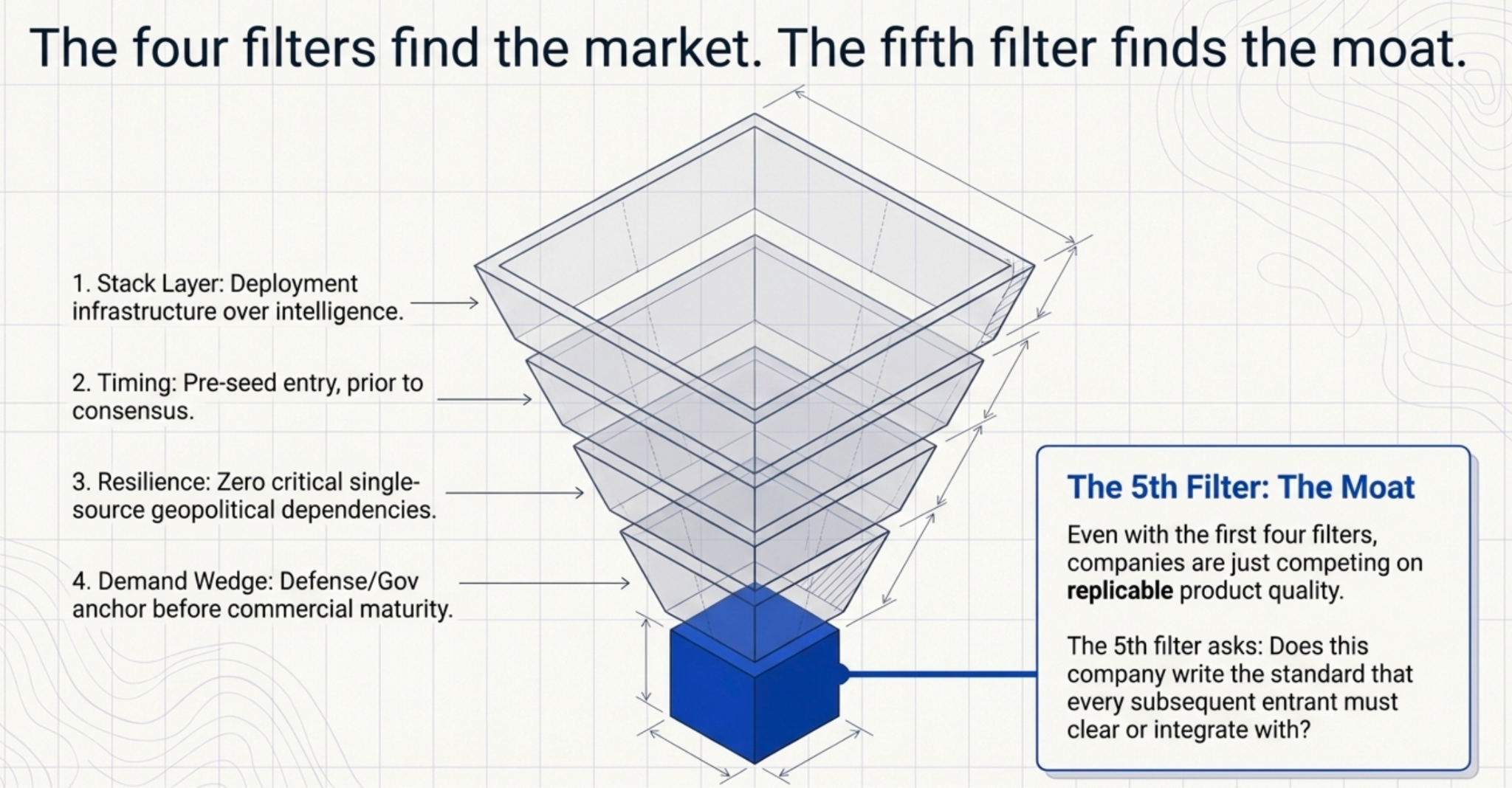
Product quality explains who wins a market. The Fifth Filter asks who sets the terms everyone else has to win by.
These four filters are PaperJet’s differentiated lens, not the field standard.
Even with these four filters applied, every company that passes is competing within the same deployment layer. Product quality itself is replicable. Given enough capital, competitors usually catch up within two to four years.
The four filters identify the right pond. The fifth filter identifies which company sets the standard inside it.
Four Verticals, One Pattern
Before constructing the framework, four concrete examples show how the standard layer forms in practice.
Semiconductor: the qualification record is the acquisition asset.
In February 2026, Marvell acquired Celestial AI for $3.25 billion. The unusual part: Celestial AI had no revenue at closing. Marvell itself guided that the first meaningful revenue would not arrive until the second half of fiscal 2028, more than two years after the deal closed, as seen in the transaction summary below:
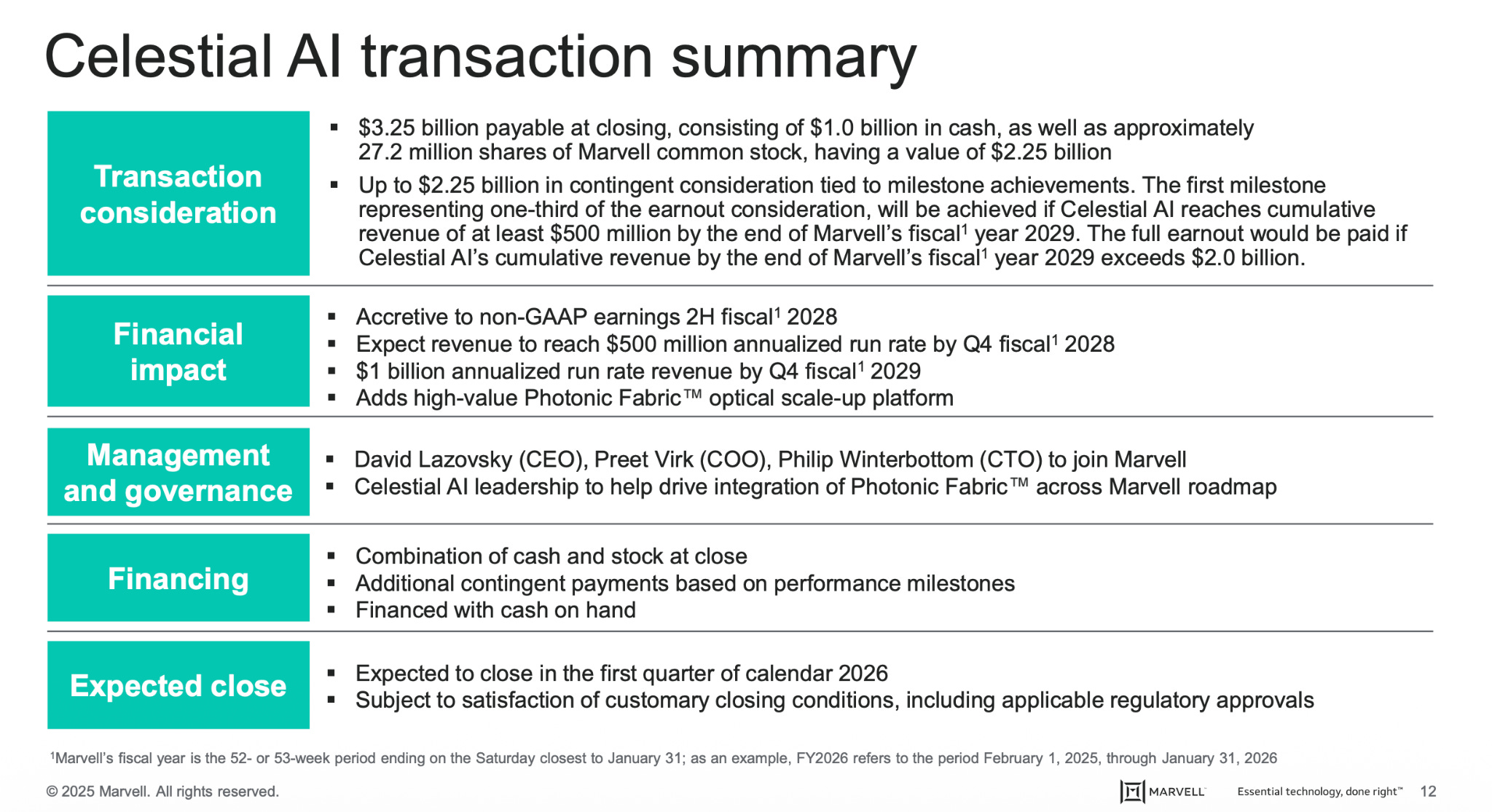
So what did Marvell pay $3.25 billion for?
Celestial AI had solved a problem every major cloud computing company will eventually face. Data center equipment cycles between hot and cool as computing workloads fluctuate. Most optical components drift out of tolerance as equipment cycles between hot and cool operating conditions. Celestial AI built a design that stayed stable. More importantly, they had years of production history proving it worked at scale under real operating conditions.
That production record was the asset, not the product or the revenue. Any team with enough money can build a competing design. No team can go back in time and accumulate years of production history proving it works.
The standard layer premium is not a thesis. It is a closed transaction - $ 3.25 billion for a pre-revenue company, priced in this market, in the last twelve months.
The question at pre-seed is whether you can identify the company making that kind of manufacturing decision before Marvell writes the check.
Robotics: the supply position before the commercial window closes
In Q1 2026, Schaeffler CEO Klaus Rosenfeld confirmed the company is engaged with approximately 45 humanoid robotics developers globally. The goal is to become the world’s leading component supplier for humanoid robots, covering strain wave gears, linear and rotary actuators, sensors, and bearings. Actuators are the most expensive subsystem in a humanoid robot, around 56 percent of the total component cost. Schaeffler is targeting an order book in the hundreds of millions of euros by 2030.
The deals announced so far show the breadth of that position. Humanoid, formerly SKL Robotics, signed an agreement to deploy thousands of wheeled units inside Schaeffler’s own factories.
That makes Schaeffler both the preferred component supplier and the anchor customer operating the robots. Schaeffler’s own investor materials list its ecosystem partners across the humanoid landscape, including Boston Dynamics, Figure AI, Agility Robotics, Unitree, and Fourier.
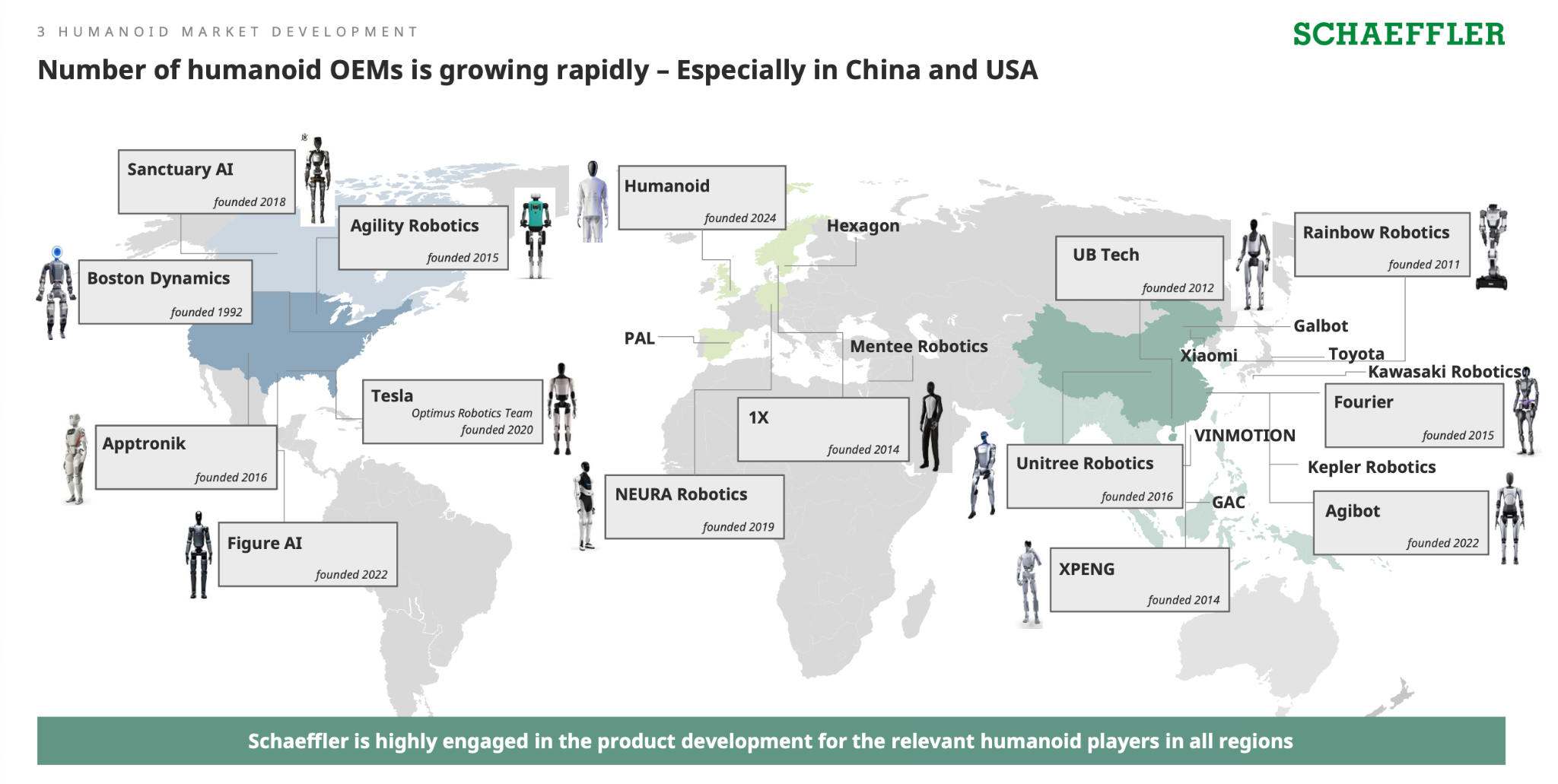
Schaeffler’s automotive-grade manufacturing infrastructure is the kind of qualification barrier a new entrant cannot replicate with capital alone. Precision tolerances, high-volume tooling, certified quality systems. Those take decades, not funding rounds.
Moving from zero humanoid exposure to preferred supplier across 45 active developers happened in under two years, before any OEM had committed to a production platform.
Once those production platform commitments are signed, Schaeffler is already inside the design process. Any new supplier trying to displace that position would require the robot maker to restart the qualification process, a rebuild that takes four to seven years. As of Q2 2026, no US company holds an equivalent preferred supplier position across the humanoid-robot ecosystem.
The asset is access to the design process. The contract is confirmation that the window has already closed.
Defense: the command and control environment is the standard, not the drone
In March 2026, the Army awarded Anduril Industries an $87 million task order to deploy its Lattice software as the command and control backbone for the Pentagon’s Joint Interagency Task Force 401 (“JIATF 401”). That task order sits under a ten-year enterprise agreement worth up to $20 billion, allowing federal agencies to purchase Anduril’s commercially available products directly.
The significance is not the dollar figure. It is what the agreement did to the buying process around it. More than one hundred previously separate procurement pathways were consolidated into a single vehicle running through 2036. Any company selling sensors, weapons, or software into the JIATF 401 ecosystem now operates within the environment that Lattice defines. Not because a contract requires it. Because the market is organized around it.
Anduril did not win by building the best drone or the best counter-drone system. It won by becoming the operating environment that every platform after it must account for. The drone is a product. The command and control layer is the standard.
The investor signal worth noting: Lattice adoption was already spreading across the ecosystem before the enterprise agreement was signed. The institutional mandate confirmed what the market had already decided. The sequence to watch is simple: integration before mandate. The contract announcement is confirmation, not an opportunity. By the time it is public, the window has already closed.
Energy: the licensing framework is the market creation event
For the last decade, nuclear energy has been one of the most discussed and least deployed solutions to the power demands facing AI data centers, defense installations, and remote infrastructure. The technology works. The bottleneck has always been the regulatory pathway. Getting a new nuclear design approved in the United States has historically taken ten to fifteen years and cost hundreds of millions of dollars in licensing fees alone. That timeline made commercial microreactor deployment functionally impossible at the scale the market needs.
In May 2026, the Nuclear Regulatory Commission (“NRC”) changed that. It published Part 57, a new licensing framework specifically designed for microreactors, under Federal Register document 2026-08550. The final rule is mandated by November 2026. The first commercial applications are possible in January 2027.
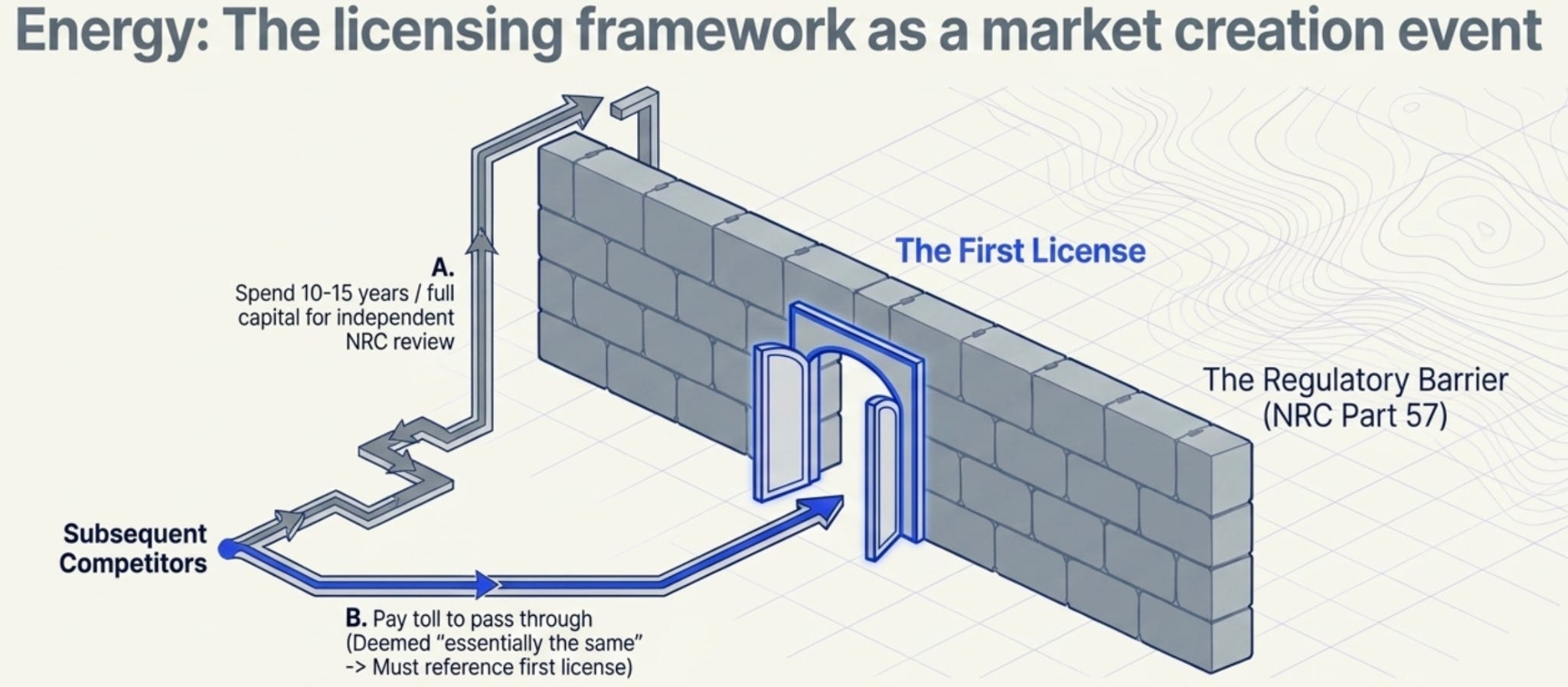
The company that files the first complete application and achieves approval on its design becomes the reference standard for the entire microreactor category. Every competing design that is not deemed essentially the same must run a full, independent NRC review at full cost. Every design that is deemed essentially the same must reference the first company’s approved license, placing that company structurally inside the approval chain for every subsequent entrant.
For investors, the pricing implication is direct. Before a manufacturing license, a microreactor company is priced as a project developer. After one, it is priced as a product platform. Those are different multiples entirely. The filing date determines the structural position. Everything else follows from it.
The question for the rest of 2026 is simple: who files first?
What a standard layer actually looks like
A standard layer company is one whose production record, licensing position, or platform architecture becomes the reference point every subsequent entrant must either match or work around. Three mechanisms explain how that position forms.
The Qualification Anchor
Think of how the FAA certifies aircraft. Once a design achieves certification, every competing design that wants to carry passengers has to clear the same bar or explain why its approach is safer. The first company to certify does not just have a product. It has set the test that every competitor takes.
In Physical AI, replicating a production record of that kind requires four to seven years of manufacturing history. That is not a problem money can solve. You cannot buy back time. For an acquirer, the asset is not the revenue. It is the irreplaceable history. Celestial AI had none of the former and all of the latter.
The Regulatory Floor Anchor
The nuclear microreactor example is the clearest version of this. The regulatory milestone is not a compliance burden for the first mover. It is the barrier that every company behind them has to clear.
Platform Integration
When Apple launched the App Store in July 2008, it did not require apps to exist. But once developers built on iOS, the cost of switching grew with every new app. Not because of a contract. Because the market is organized around the platform. The standard was set before anyone formally declared it.
The same thing happens in Physical AI. Lattice adoption spread across the defense ecosystem before the JIATF 401 enterprise agreement was signed. The mandate confirmed what the market had already decided. The advantage does not require a contractual lock. It requires the market to organize around you before alternatives are formalized.
One distinction matters. A supply relationship available to every participant in a category is shared infrastructure, not a standard layer position. BWX Technologies, Inc. (“BWXT”) supplies fuel and reactor components across four simultaneous microreactor programs. Access to BWXT is a cost of participation. The Fifth Filter applies only to positions that gate competitors out. If every company in the category has the same access, no one holds the standard layer.
Robotics does not fit cleanly into any single mechanism. Schaeffler’s position combines elements of all three: a production qualification barrier new entrants cannot replicate, a supply position secured before the selection window closed, and a presence across enough platforms that displacing it requires the robot maker to absorb the cost of starting over. That combination is what makes the actuator supply position the most instructive example for founders. The window does not announce itself. It closes when production platform commitments are signed.
China sees this more clearly than US capital does
To understand where the Physical AI landscape is heading over the next decade, it helps to look at how China is funding industrial standards rather than individual products.
China’s Ministry of Industry and Information Technology (“MIIT”) published its 2025 National Key R&D Program pilot industrialization list in January 2026. It is a state-level commitment to move specific research outcomes from laboratory to production scale within two years, with co-investment from regional governments and designated industrial parks. Four items map directly onto the deployment gap thesis.
The magnets that power every robot joint
Every major Western humanoid design depends on a material that China has just made harder to get. That is not an accident.
The motors inside humanoid robot joints run on permanent magnets. The dominant type is NdFeB, short for neodymium iron boron. It is what gives motors the power density required to move a human-scale limb with precision. Without it, the performance standard of every major Western and Japanese humanoid design collapses.
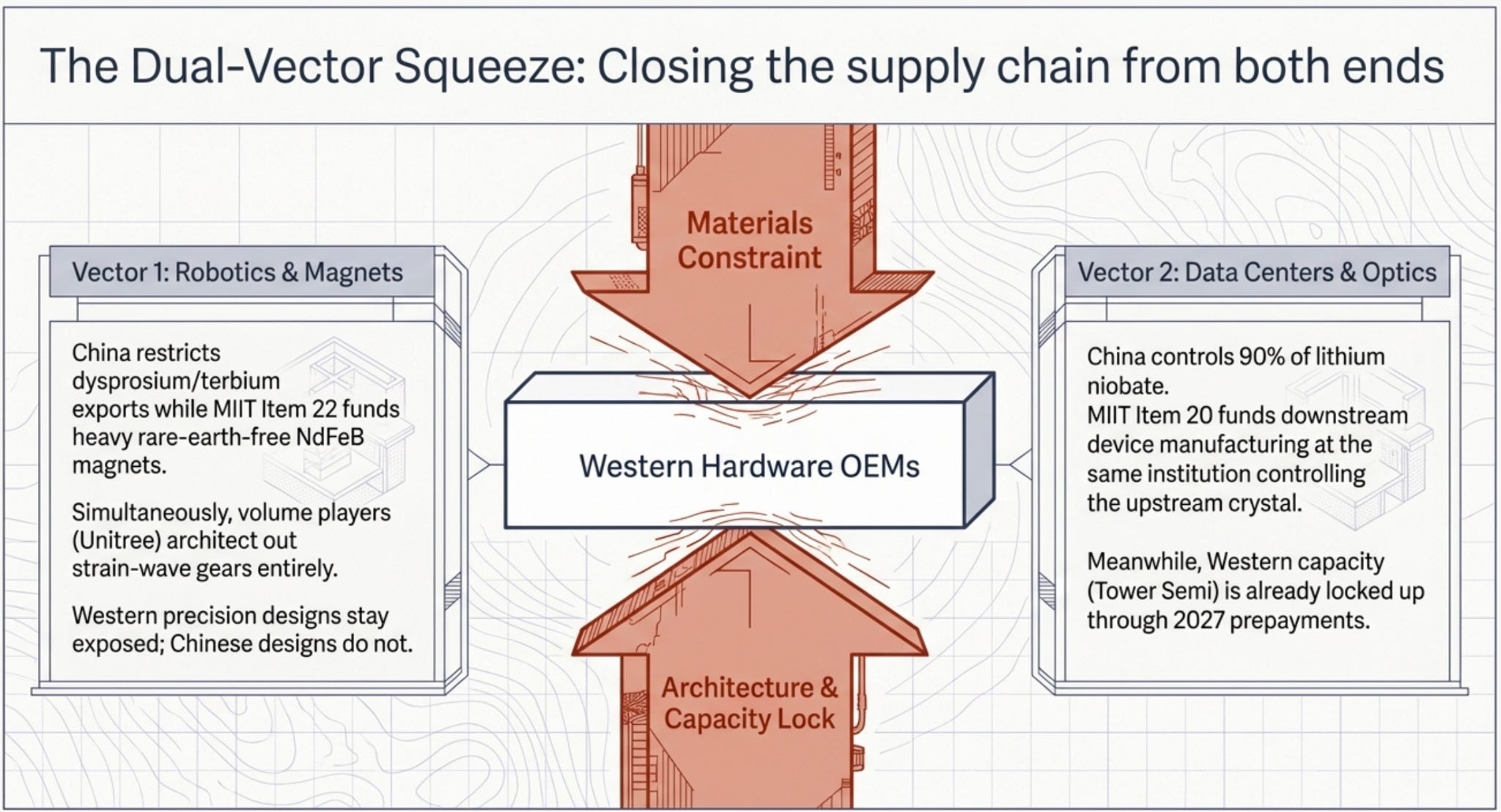
Current NdFeB production requires two additional rare earth elements, dysprosium and terbium, to prevent magnets from losing their magnetic strength when motors heat up under load. In April 2025, China introduced export controls on both elements. Western humanoid manufacturers depend on these elements, and China controls the overwhelming majority of global processing capacity.
MIIT Item 22 is China’s program to build a new NdFeB magnet formulation that achieves the same performance without dysprosium or terbium, with a target production scale by 2027. Within months of the MIIT list’s publication, Japan’s Proterial, the dominant global NdFeB patent licensor formerly known as Hitachi Metals, scheduled its own heavy rare earth-free NdFeB pre-production samples for April 2026.
Two national programs reaching the same milestone in the same period confirm that the technology has crossed from laboratory to production readiness. As of June 2026, no equivalent domestic production program exists in the United States.
That is the first vector. China removes its own dependency on the constrained elements while export controls remain active against Western manufacturers. Western precision actuator designs stay exposed to the supply restriction. Chinese designs will not.
The second vector is architectural. Unitree, the highest-volume Chinese humanoid currently deploying at scale, uses a different motor and gearbox design called Quasi-Direct Drive that reduces rare earth requirements at the system level by eliminating strain wave gearboxes. This was a deliberate design decision to make the platform less dependent on the highest-grade magnets while remaining cost-competitive.
China is not responding to a rare earth constraint. It is using one. The formulation program removes the dependency. The export controls keep it active against everyone else.
Two simultaneous strategies. One at the materials level, one at the architecture level. Western manufacturers face pressure from both directions. Chinese manufacturers are being designed to avoid it. The runway is two years. The playbook is the same in the next section.
The component that makes AI data centers run faster
Every major AI data center upgrade underway right now depends on a technology called co-packaged optics. The basic idea: instead of sending data between chips through copper wires, which generate heat and slow down at scale, co-packaged optics sends data as pulses of light through fiber. The result is dramatically lower power consumption and higher data throughput across the same rack of equipment.
The component that makes this work is the laser modulator. It takes a steady beam of laser light and switches it on and off billions of times per second, turning computer data into light pulses that travel through the system. Without a reliable laser modulator, co-packaged optics does not work at the data center scale.
The key material inside that modulator is lithium niobate. China controls more than 90 percent of the global lithium niobate crystal supply.
MIIT Item 20 is China’s program to build the manufacturing capability for the finished optical device that sits directly above that crystal supply, completing vertical integration from raw crystal through finished component. The executing institution is the Fujian Institute of Research on the Structure of Matter, the Chinese Academy of Sciences’ principal crystal research center. The institution that controls the upstream material is now building the downstream device manufacturing.
The pressure from the other direction is arriving at the same time. In April 2026, Tower Semiconductor secured supply agreements guaranteeing approximately $1.3 billion in contracted revenue for 2027, including $290 million in prepayments from its largest customers. That level of contracted backlog means available manufacturing capacity for producing these optical components is already spoken for well in advance. A Western startup that has not secured access to manufacturing is not facing a pricing problem. It is facing an availability problem.
Quantum and fusion sensors for GPS-denied defense applications
GPS can be jammed or simply unavailable in contested environments. When that happens, autonomous systems fall back on measuring physical forces directly: magnetic fields, acceleration, and orientation.
Diamond NV sensing measures magnetic fields at the atomic scale. Unlike earlier quantum sensing approaches, it works at room temperature and normal atmospheric pressure, in the ocean, in orbit, anywhere in between. MIIT Item 46 commits the University of Science and Technology of China to move it from lab to production for defense applications. The target applications are GPS-denied navigation, submarine detection, and autonomous system orientation without satellite dependency.
At the integration layer, MIIT Item 36 commits Hebei Meitai Electronic Technology to mass produce GPS and inertial measurement fusion sensors at automotive-grade precision and Chinese cost curves. An inertial measurement unit tracks acceleration and rotation directly, measuring position and movement without any external signal. When GPS is unavailable, the inertial system takes over. The architecture is the same sensor combination powering Chinese autonomous vehicles, which have accumulated more real-world deployment data than any Western equivalent. That civilian production base now provides the infrastructure for autonomous military systems, including drones, at commercial cost.
China is not funding a GPS-denied navigation product. It is funding the entire navigation stack, from the quantum sensing component through the system integration layer, simultaneously, through two separate institutions, on the same two-year timeline.
As of June 2026, no named US company is commercializing diamond quantum magnetic sensors for defense applications. The entry window is measured in months, not years.
The pattern across all four
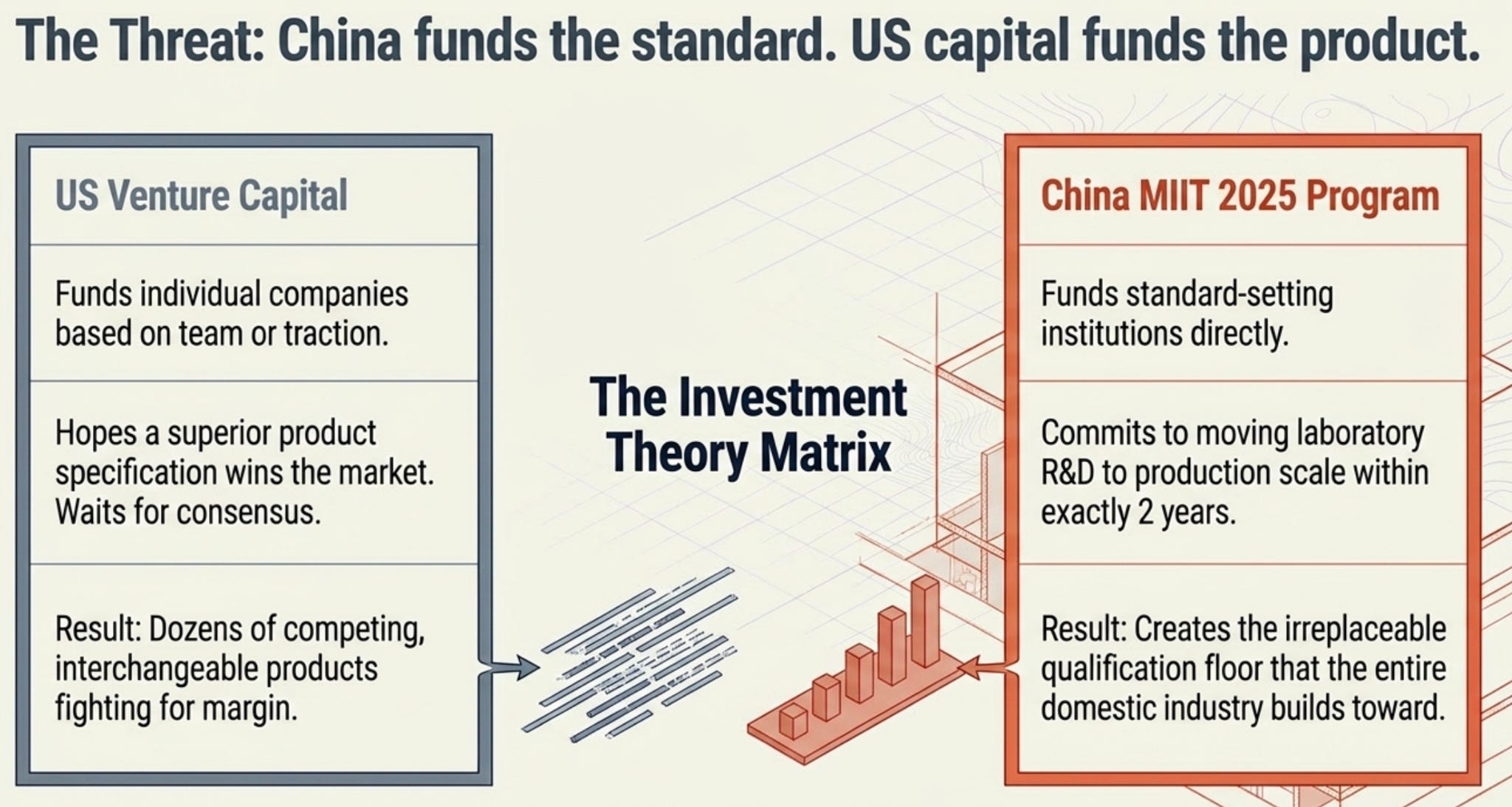
Each of these four programs funds a standard-setting institution, not an individual company. The output in each case is a qualification floor that the entire domestic Chinese industry builds toward. Competing designs reference it, build to it, or explain why they diverge from it.
US capital funds individual companies competing on product specifications and hopes that a leading one sets the standard on its own. The MIIT list is not evidence that China has better technology. It is evidence of a fundamentally different theory of how standards get built.
That difference is what the Fifth Filter is designed to surface. US capital waits for a product winner to emerge. The MIIT list funds the floor the winner has to build on.
How to identify the standard layer company before the standard exists
The standard layer is only visible after the window has closed. By the time the acquisition is announced, the application is filed, or the enterprise agreement is signed, the structural position was already established two to four years earlier.
The data is visible years before the capital follows.
The signal is not the standard itself. It is whether the company is in the room where the standard gets written.
Four observable signals indicate a company is building toward standard layer access before the standard exists.
Procurement Anchor
The first signal is a company that is part of a major government or industry program and generates the first qualification record in the category. The company is not applying to the program from outside. It is inside the program, producing the data.
Project Pele, the Department of Defense mobile microreactor demonstration built by BWXT, is the clearest current example. Any company that generates operational safety data from a deployed military microreactor is structurally ahead of every subsequent entrant that has to produce that data from scratch. The qualification record is the asset. The program is where it gets built.
Regulatory Access
The second signal is a company named in the regulatory development process as a reference design. Not filing public comments. Being cited by the regulatory body itself as evidence that the approach works.
The nuclear example shows how this works across both defense and commercial markets. A company with existing government authorization can reference that authorization in a commercial NRC application under Part 57. The regulatory body wrote that provision because prior government authorizations are the strongest available evidence that a design is safe. A company that has generated that evidence through a defense program compresses the commercial review for any related design. That is a structural head start that cannot be replicated through lobbying or policy engagement alone.
Platform Integration Adoption
The third signal is that other companies are designing their products to work with a platform’s architecture before anyone requires them to. The sequence matters: adoption comes before the mandate. By the time the mandate is formalized, the standard layer window has already closed.
The Lattice example in defense shows this directly. Partners were already building in the Lattice environment before the enterprise agreement consolidated the procurement pathways. Investors who waited for the contract announcement were reading yesterday’s news.
Supply Position before Commitment
The fourth signal is a company that has secured preferred supplier access across multiple platforms before any manufacturer has committed to production. The Schaeffler example makes this concrete: the opportunity is not the supply agreement itself. It is the period when the manufacturer is still deciding what goes inside the product. A company already in the design process across multiple platforms before production commitments are signed becomes the default choice. The commitment announcement confirms the window has closed, not that it has opened.
The investment question at the pre-seed stage is not whether the product works. It is whether this company is structurally positioned to become the reference point before the market formally recognizes it as one.
The Cost of Running Only Four Filters
Two types of companies pass the first four filters. Only one passes the fifth.
Companies that pass four filters build real products with real customers. They compete on specifications. Margins compress over time. The acquisition multiples reflect revenue and growth. These are good companies. They are just not the standard.
Companies that pass all five write the production record that their acquirer cannot replicate. They set the regulatory parameters that competitors must design to. They become the operating environment their ecosystem depends on. The acquisition multiple reflects structural irreplaceability, not current revenue.
The Celestial AI transaction makes the difference concrete. $3.25 billion for zero current revenue, with a two-year lag to first meaningful contribution. The standard layer premium is not a thesis. It is a closed transaction, priced in this market, in the last twelve months.
Every fund says it wants to find the company that becomes the platform. Most are funding companies that build for someone else’s platform. The Fifth Filter is the framework that separates those two outcomes before the difference is visible.
The companies that pass the fifth filter are not recognizable as standard-setters at the moment of entry. They look like good products in the right layer. The standard layer status becomes visible later. The entry window is only open earlier.
That is the cost of the framework. It requires conviction before consensus. The moment the consensus arrives, the window has already closed.
Close: Three Clocks, One Tradeoff
Three verticals in this essay are at three different points on the same clock.
Lattice: the window is closed. The $20 billion enterprise agreement is signed. More than one hundred previously separate procurement pathways are now consolidated into a single vehicle running through 2036. Any company building into the JIATF 401 ecosystem is building into Anduril’s operating environment. The standard is set.
Part 57: The clock starts in January 2027. The final rule is mandated by November 2026. The first company to file a complete application and achieve approval sets the reference design for the entire microreactor category. Every competitor after that either designs to those parameters or pays for a full independent review. The filing date determines who holds the structural position, and the clock is now running.
Actuator supply: the window is in progress. Schaeffler has five customer contracts and active engagement across 45 developers. The selection window closes when the remaining mid-tier Western manufacturers commit to production platforms, approximately 12 to 24 months away, based on the platform commitment timelines we track. No US company holds an equivalent position across the humanoid robot ecosystem as of mid-2026.
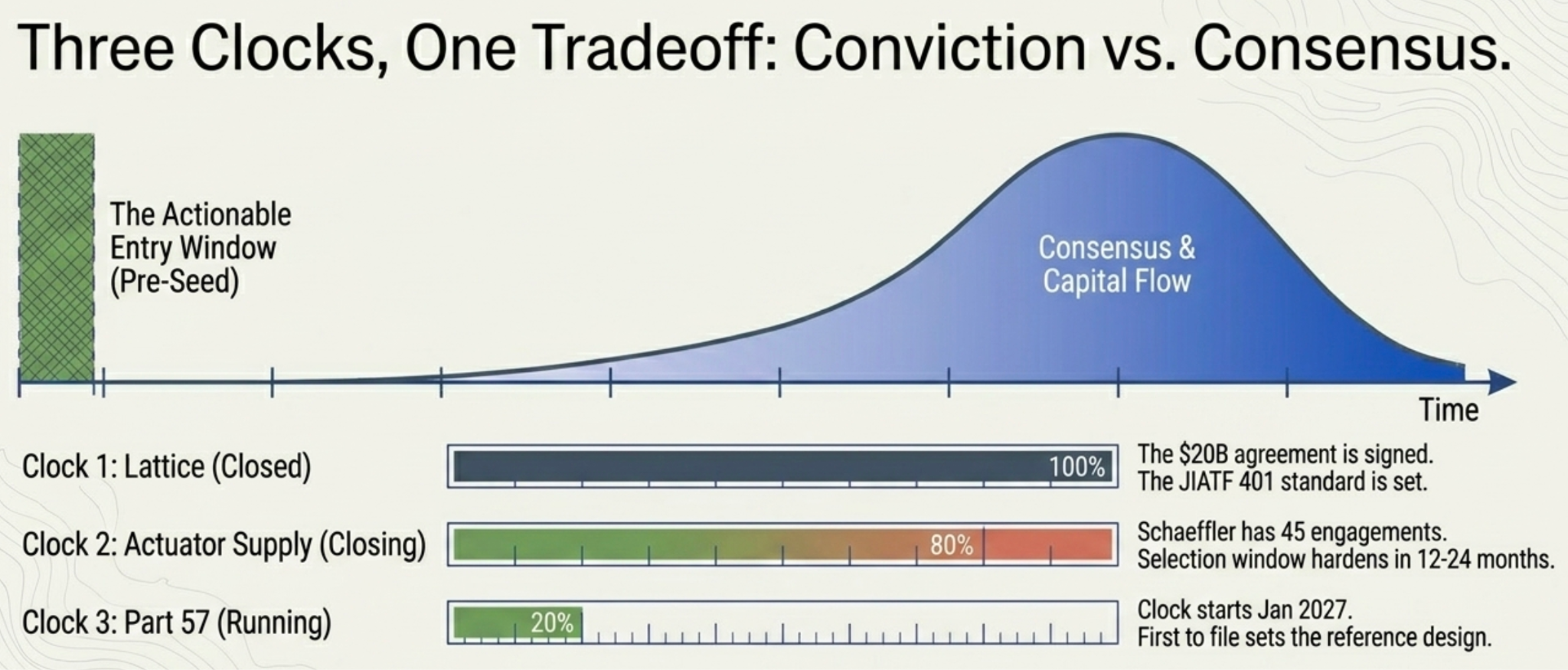
The Fifth Filter is only actionable before the standard is written. One window is closed. One starts in January. One closes in 12 to 24 months. The only question is which of those clocks you are watching.
love this article. US investors should really worry about China's funding the floor everyone builds on, while US capital funds individual companies and hopes one becomes the standard.
going to read this tonight after a quick brief through now
you might want to know about what we are doing to bridge the atoms to bits divide in construction — a key part of physical AI
learn more
http://deck.builtdata.io