

Marvell paid $3.25 billion for Celestial AI in February, with the company generating no revenue at close. First meaningful revenue is not expected until fiscal 2028. A well-funded competitor could build a similar design in a year. What they cannot buy is four years of product history.
The Fifth Filter called this structural irreplaceability, a premium that has nothing to do with revenue and everything to do with what a competitor cannot replicate on the same timeline. Marvell wasn't buying a chip. It was buying four years nobody else had.
Chasing the next SpaceX is one way to build a deep tech portfolio. It isn’t the only one. There’s a second path: finding companies positioned to become acquisition-ready long before the public markets or later-stage investors value them that way.
Some get bought at a premium. Some grow into the generational company themselves. Either outcome can work. The harder question is when the first outcome becomes predictable enough to underwrite.
M&A already happens in deep tech. The question is how early you can see the conditions that make an acquisition predictable.
If you're investing in, advising, or working with companies in physical systems, this is the framework we're using to think about acquisition timing.
What this essay argues
There is no universal M&A clock. Acquisition timing depends on what forces the buyer’s hand.
Semiconductors have a tested qualification clock. Robotics has a plausible mechanism but no tested interval yet.
Defense follows a different pattern. Supply constraints, program needs, and regulation can set the clock.
The underwriting risk is borrowing a timeline from one vertical before a transaction proves it applies to another.
Semiconductors: Qualification Moat
In semiconductors, a qualification record, not a working chip, is what a hyperscaler is actually paying for. Photonic integrated circuits shift wavelength under heat, roughly 0.1 nanometers per degree Celsius, and a failed optical engine inside a co-packaged switch can take down the entire board, not just one swappable module. Proving a design holds up under sustained, high-heat compute loads over years, not a lab demo, is what that qualification record actually verifies, and no amount of capital shortens the cycle.
That cycle runs two to three years in current practice, a range confirmed independently of the Celestial AI transaction itself. Industry practitioners tracking hardware development timelines report the same window. That convergence is what gives semiconductors a tested clock. We have a real transaction and a separate industry estimate, and both land in the same range.
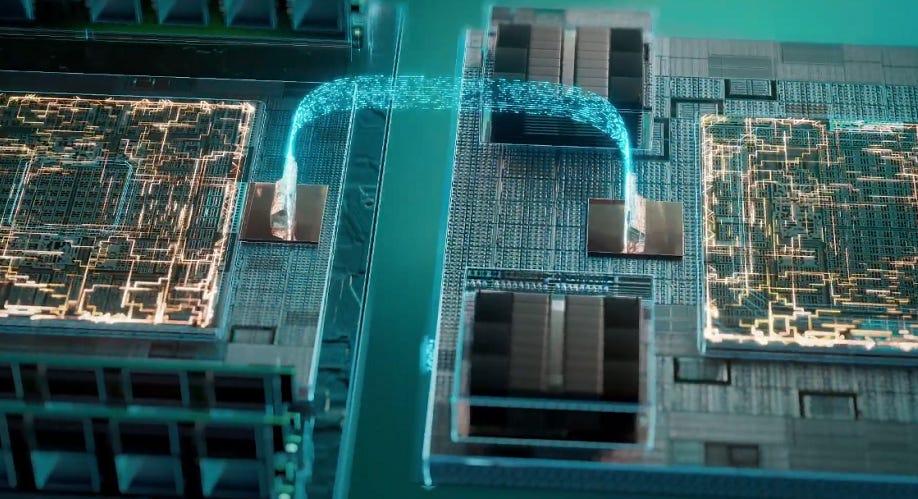
Celestial AI’s asset was Photonic Fabric, an optical interconnect platform that transmits data as light rather than electrical signals over copper. The scarce asset wasn't the technology. It was four years of production history proving the design stayed thermally stable. That stability mattered as data center racks cycled between hot and cool operating conditions. That was the failure point that stalled competing designs before they reached a customer. That stability record took four years to accumulate, one qualification cycle at a time.
At PaperJet, we use the same progression when we underwrite companies. Not every company clears all three gates in the same way or in the same order.
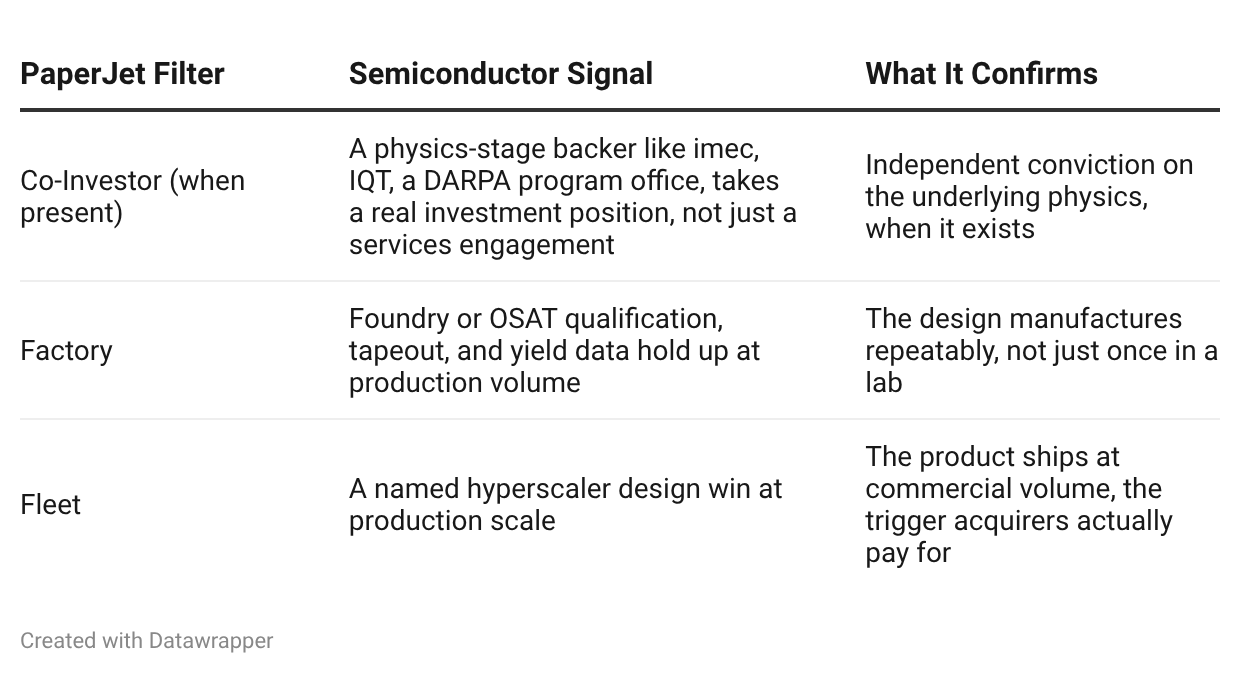
Some of our strongest positions came from our own underwriting, research, portfolio-company pattern matching, and subject-matter experts before any outside validator was in the picture.
Celestial AI's own record maps cleanly onto this filter, and it cleared all three. Imec, the Belgian research institute that validates physics at the earliest stages, invested in the seed round rather than just providing services, and cleared the co-investor bar years before Marvell bought the company. Foundry qualification cleared the factory gate. AWS's endorsement of the finished product was the fleet signal, the one that moved Celestial from a validated design toward an acquisition target. Not every company we back will have that first checkpoint. When it exists, it's a real signal, but the factory and fleet signals can still carry the underwriting.
Robotics: The Untested Trigger
In robotics, a lab demo does not make a hardware-software startup acquisition-ready.
Two conditions must be met first. The system has to run across more than one company's hardware, including industrial robot arms from manufacturers like FANUC and ABB, as well as the factory systems layered on top. It also needs a sustained field record, with multi-platform qualification and at least 12 months of active deployment data. That data has to show the system holds up outside a controlled lab, under inconsistent lighting, temperature fluctuations, and objects that differ slightly from anything it trained on.
A competitor entering from outside that dataset cannot replicate it on any acquisition-relevant timeline.
Simulation tools like NVIDIA Isaac have closed much of the motion-planning gap, but a simulated robot never actually meets a factory floor. Deployed hardware accumulates wear, drift, and failure modes that only surface at volume.
The safety rulebook is still catching up to the hardware, too. Industrial robot safety standards were just overhauled in 2025, and even that new version assumes a robot bolted to the floor, not a humanoid walking around one; the standard covering legged robots specifically is still being written. A single unhandled incident during a pilot doesn’t just delay the program. It resets the one thing the buyer is actually paying for: the confidence that the qualification record holds.
No transaction exists yet to test whether this timing holds in robotics the way the Marvell-Celestial AI deal does in semiconductors. One recent deal looks like a counterexample and isn’t. Mobileye’s $900 million purchase of Mentee Robotics in January 2026 was priced between related parties; Mobileye’s own CEO co-founded Mentee. It closed before Mentee had cleared either qualification test.
The other live case worth naming is even murkier. Anthropic and Physical Intelligence held acquisition talks this spring, as reported by The Information, though no deal has emerged and Physical Intelligence’s response stopped short of a firm denial. Even that attempt sits inside a complication unique to this vertical: OpenAI is already an investor in Physical Intelligence, which may give it the stronger claim to any future sale than a rival trying to buy in from outside.
We’re watching three signals.
Teleoperation data is the first. It’s still an early, unmatched category with no commercial product built around it.
Actuator integration is the second. Schaeffler has secured preferred supplier positions across multiple humanoid platforms, with named agreements spanning Neura Robotics, Humanoid, and Leju Robotics.
Tactile sensing is the third. Several suppliers are competing on sensor integration, but none has established a dominant position across OEMs yet.
These are our own read on the market, not a confirmed pattern.
Defense: Deadline Clock
Anduril’s acquisition of Adranos followed a specific defense pattern: a small supplier demonstrates technology readiness with non-dilutive government funding, then a prime buys the finished capability rather than building internally. Adranos demonstrated ALITEC, an aluminum-lithium alloy solid rocket propellant, in a live Army-backed flight test in 2019, proving roughly a 40 percent increase in range over conventional propellant.
The flight test mattered, but it didn't start the acquisition clock. It showed technical progress, not a reason to expect a deal.
What actually set the clock running was the structural shift happening around it. Solid rocket motor supply had narrowed to two dominant primes, Northrop Grumman and Aerojet Rocketdyne. That left Anduril facing the same two suppliers as every competitor, with no independent source of its own.
The deal closed in June 2023, roughly 43 months after the flight test, longer than the 24 to 36-month window that governs semiconductors. That’s not a claim about defense’s average time to exit. One transaction isn’t an average. It’s the one tested comparable we have, and the 43-month figure only makes sense once you understand why: the duopoly risk above, not the propellant test.
The Army’s 2025 decision to have Anduril build a new 4.75-inch rocket motor is the actual proof the bet worked. It handed Anduril production work on the exact capability it bought Adranos to secure.
The same logic shows up elsewhere, at an earlier stage. Anduril’s acquisition of Blue Force Technologies priced IP, facility footprint, and pipeline position months before Fury had cleared wind-tunnel testing, let alone a completed qualification record. Anduril was buying position before proof, the same sequence Adranos followed, just earlier in the company's life.
The clearest forcing event here is regulatory. Starting January 1, 2027, US defense contracts will require neodymium and samarium-cobalt magnets used in motors and actuators to have a documented mine-to-magnet supply chain with no material sourced through China. Almost no supplier can prove that chain today.
Expect the same pattern that played out with Adranos. Primes have an incentive to acquire small, compliant suppliers ahead of the deadline, not because those suppliers have years of field data, but because after January 2027, being compliant is the only way to keep selling at all.
Three different forcing events produce the same acquisition behavior: a shrinking supplier base, a prime’s roadmap need, or a regulatory cliff. Defense doesn’t run on the qualification clock semiconductors run on. It runs on whichever deadline arrives first.
Why the Buyer Class Tells You Which Clock, If Any, Applies
For industrial automation incumbents including Fanuc, ABB, Schaeffler, Bosch, and Siemens, the trigger isn’t robot capability. It’s where an acquisition ranks against every other use of the same capital.
Hyundai’s Georgia Metaplant is the clearest example. From the outside, it looked like a bet on American manufacturing. Inside the boardroom, it was a reset of the depreciation clock, an IRA eligibility fix, and an escape from a Korean labor environment that made automation uneconomic rather than merely difficult.
Hyundai didn’t automate Korea harder. They removed the constraints that made automation uneconomic in the first place.

That's the comparison every robotics startup is competing against: every other way the buyer could deploy capital to reset the system. The acquisition only makes sense once it beats that alternative at a price justified by four to seven years of internal replication.
Humanoid OEMs, Figure AI, Apptronik, Boston Dynamics, Agility Robotics: the trigger is becoming a critical, multi-platform supplier before a competitor locks up the same position.
Schaeffler secured preferred supplier status across Neura Robotics, Humanoid, and Leju Robotics within 18 months, engaging roughly 45 developers globally. That’s the kind of position an OEM can’t risk letting a rival own first.
Defense primes, with Anduril as the reference acquirer: The trigger can be a program deadline, a supply constraint, or a regulatory cliff. The forcing logic is the same, but the clock is set by the defense environment rather than a qualification record.
Semiconductor contract manufacturers, Amkor, Samsung, Lumentum, Coherent: the trigger is customer qualification and production readiness. It’s the same three-gate progression Celestial AI already proved, but here the buyer is acquiring the capability to compress its own timeline.
The Regulatory Archetype Worth Watching Now
Regulatory deadlines create different acquisition pressures depending on who has to respond. We see three patterns.
Eligibility Cliff - A regulation that names specific companies as banned, with compliance required or the contract lost outright.
Margin Cost - A tariff adds to an ongoing cost. Comply or keep paying a penalty on every unit, indefinitely.
Credential Value - A qualification list. Comply or spend years earning access another company already has.
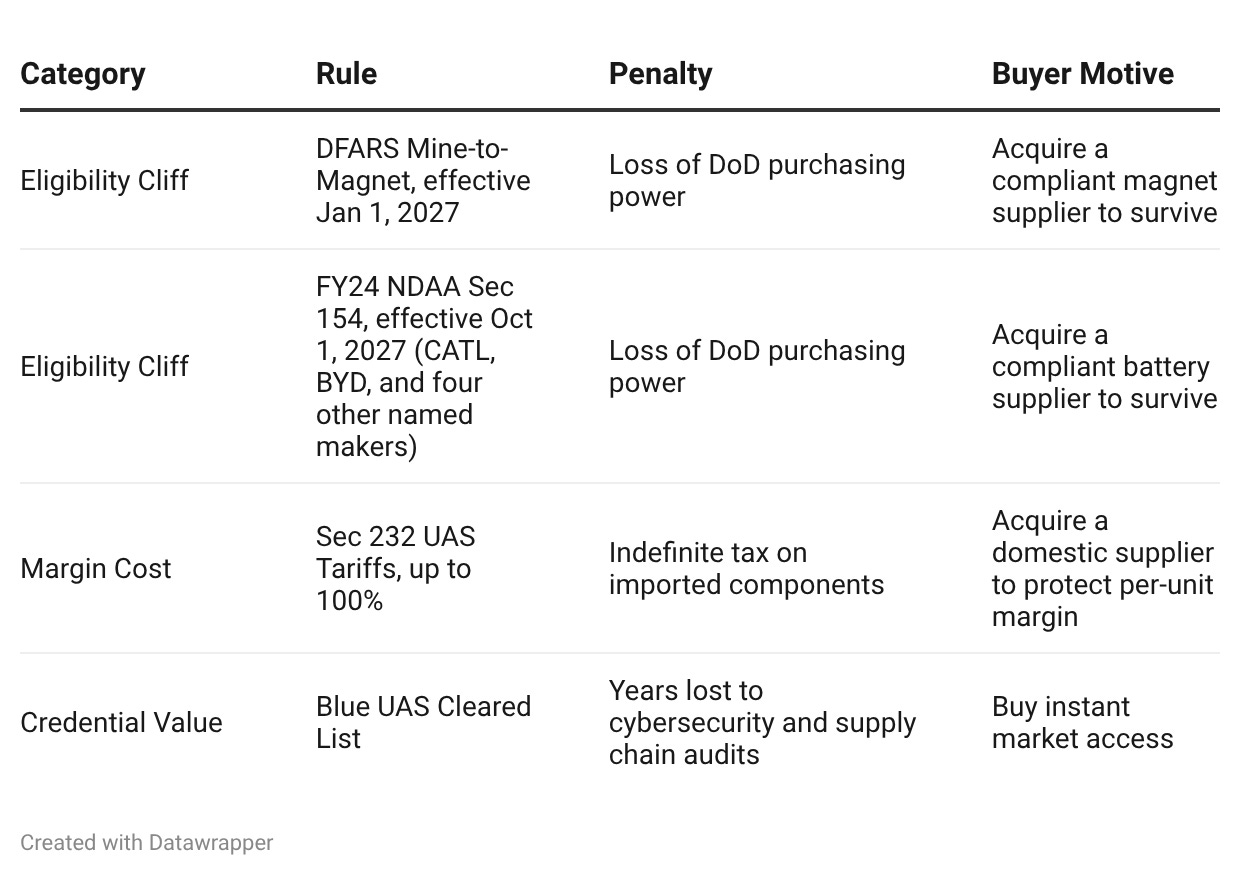
All three are active in defense procurement, and they’re not limited to one component category. Magnets, as covered above, fall in the eligibility category. Batteries below sit in the same category through a different regulation entirely.
Compliant Battery Supply
FY24 NDAA Section 154 cuts off Department of Defense purchasing power for six named Chinese battery makers: CATL, BYD, Envision Energy, EVE Energy, Gotion, and Hithium, starting October 1, 2027. After that date, a battery is prohibited if any of those entities assembled or manufactured the final product, or supplied a majority of its components.
Every defense contractor running a battery-dependent program needs to know where its cells actually came from well before the deadline hits. A prime with battery-dependent programs has a clean incentive to acquire a compliant supplier now, ahead of the date, rather than scramble for one once the window closes. Amprius, a battery supplier to AeroVironment, is the live example. It's working toward NDAA compliance, but hasn't cleared that bar yet.
Tariffs on Imported Drones and Key Hardware Components
Section 232 UAS tariffs, signed August 13, 2026, hit imported drones and components with layered timelines and rates, not a single number.
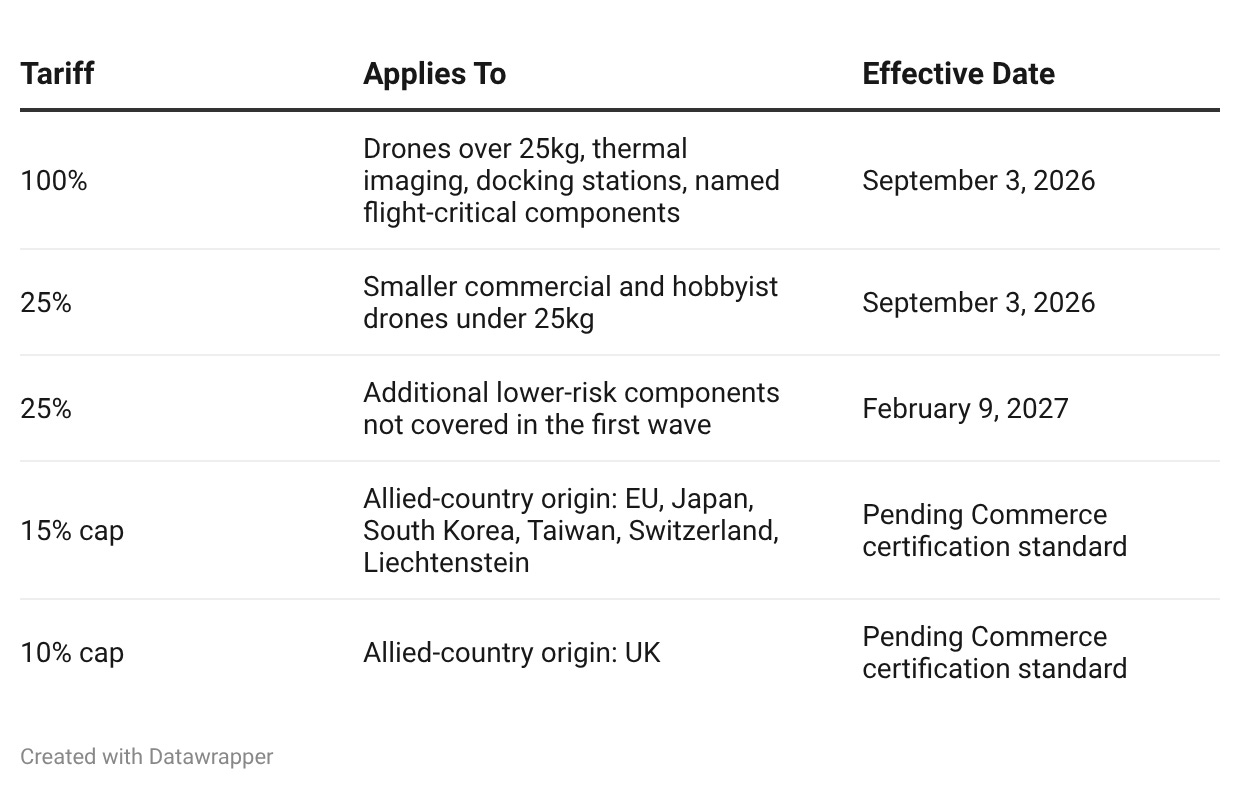
A prime facing a 25 to 100 percent cost overhang on imported components has an incentive to acquire a domestic or already-compliant supplier, not for eligibility, but to protect margin on every unit shipped.
Blue UAS Cleared List
A separate mechanism worth tracking: the Blue UAS Cleared List, the Department of Defense’s own roster of drone platforms and components already cleared for military and federal purchase without further review. Getting listed independently takes time, including cybersecurity audits and supply-chain verification. Most companies don't clear that process quickly. The current Blue UAS Cleared List includes dozens of platforms from AeroVironment, Anduril, Shield AI, Skydio, Teal, and others.
That gives larger companies a reason to acquire a company already on the list rather than wait out the process themselves, buying instant market access instead of building eligibility from scratch. The logic mirrors the semiconductor qualification pattern from earlier in this essay: buying a credential that took years to earn is often cheaper and faster than earning it directly.
Closing Note
The bigger risk is pricing a position against the wrong category, then expecting liquidity on a timeline the position was never actually running on. A defense deal priced against the semiconductor window, for example, would imply a 24 to 36-month exit. The tested Adranos transaction says otherwise.
So which of these four categories does the timeline actually fall into?
A tested interval, backed by real outcome data.
A specified but unconfirmed mechanism.
A borrowed number nobody’s checked.
A tested number that overturns the assumption everyone defaults to.
The semiconductor vertical is the only one that sits in the first category right now. Robotics sits in the second: a real mechanism, but no transaction old enough to test it. Defense sits in the fourth. Adranos ran for 43 months, longer than the 24- to 36-month semiconductor window. That tested result rules out borrowing that window for defense. The third category isn't occupied by any vertical in this essay yet. It's the mistake waiting to happen: borrowing the semiconductor window for robotics before a transaction confirms that it holds there too.
We don't have enough outcome data to call the framework proven yet. What we have is an opportunity most later-stage capital can't take. A fund waiting for category-one certainty across every vertical is waiting for the comp to already exist, and by the time it does, the price has moved.
That’s the opportunity at pre-seed: pricing a mechanism before the transaction exists to test it, or a number before anyone has confirmed whether it holds.